December 4 outside Gruntner's General Store
The Old Woman’s Warning
Outside the store, the [unnamed narrator](entity:character-recall-character-unnamed-narrator-66e83df570e7) encounters a tiny old woman wearing enormous dark glasses. When he makes small talk about the unseasonably warm weather, she tells him to get away quickly, though he later doubts what he heard.
Her warning gives direct voice to the danger that [Fehringer](entity:character-recall-character-fehringer-e5cdbcdcb16d) only circles around. The narrator nevertheless returns to the [Vacation House](entity:location-recall-location-vacation-house-f1a6ddb30b38), allowing the warning to become one of the many messages he will recognize only after escape seems impossible.
December 4 evening
The Persistent Empty Reflection
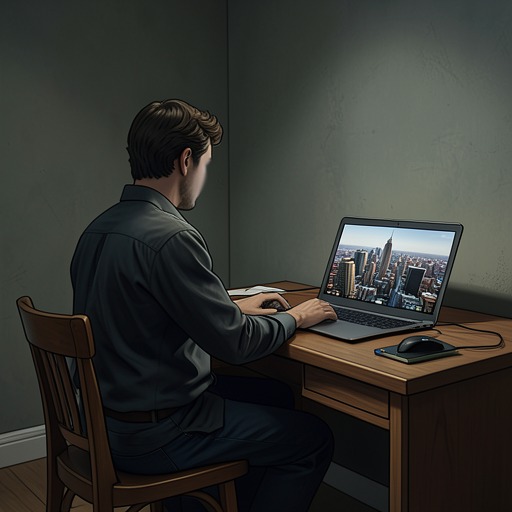
Back at the [Vacation House](entity:location-recall-location-vacation-house-f1a6ddb30b38), the [unnamed narrator](entity:character-recall-character-unnamed-narrator-66e83df570e7) again sees the room reflected in the window without himself in it. This time the absence persists: he can cover the notebook, move his hand, and observe objects that should be blocked by his body.
The reflection returns only when he looks away and back, leaving him dizzy and uncertain whether the event truly occurred. He writes it down as a defense against future self-doubt, making the notebook both witness and participant in the distortion.
December 4 evening
The Missing Photograph
Remembering the terrifying woman from his dream, the [unnamed narrator](entity:character-recall-character-unnamed-narrator-66e83df570e7) searches the laundry room for the photograph he recalls beside the washing machine. The photograph, its nail, and even any hole in the wall are absent; indeed, the house contains no pictures at all.
The disappearance undermines the most rational explanation for the dream. Memory no longer merely misrepresents the house; it seems to describe objects that the house can remove or generate at will.
December 4 night
The Bathtub Distortion
While bathing [Esther](entity:character-recall-character-esther-b91ff5ee0c38), the [unnamed narrator](entity:character-recall-character-unnamed-narrator-66e83df570e7) finds that the faucet appears farther away than it should be. His arm cannot reach an object that seems close, but after closing his eyes and reopening them, ordinary distance returns.
The incident extends the house’s strangeness from reflections into bodily space. Esther’s presence makes the episode seem almost comic, yet her later fear of being alone confirms that the child too senses the house’s altered rules.
December 4 night
Esther Fears Solitude
[Esther](entity:character-recall-character-esther-b91ff5ee0c38) tells the [unnamed narrator](entity:character-recall-character-unnamed-narrator-66e83df570e7) that she does not want to be alone in her room because everything becomes different when no one else is there. She finds it strange that only the person speaking can hear the words.
Her explanation is childlike but philosophically precise: shared presence stabilizes reality. The narrator recognizes something in it, even as he reassures her and reads until she falls asleep.
December 4 night
Marriage Strains Again
[Susanna](entity:character-recall-character-susanna-cf043f83c901) complains about needing a better agent, and the [unnamed narrator](entity:character-recall-character-unnamed-narrator-66e83df570e7) silently reflects that roles become scarce for actresses over forty. They discuss family obligations and friends’ divorces, but when he reaches for her hand she rejects intimacy because she is tired.
Their restrained exchange shows how professional disappointment and marital fatigue coexist beneath the surface of normal family life. The narrator responds with a polite excuse about mountain air, concealing how isolated he already feels.
pre-dawn December 5
The Second Dream
The [unnamed narrator](entity:character-recall-character-unnamed-narrator-66e83df570e7) dreams again of the empty room and the woman with narrow eyes, who briefly becomes [Susanna](entity:character-recall-character-susanna-cf043f83c901). He flees through the house, repeating “[Get away](entity:expression-recall-expression-get-away-7538652fe5fa),” and wakes while simultaneously feeling himself outside in the cold, locked out of the bedroom.
He experiences the dream and waking world as overlapping states. Although he eventually senses reality shifting back into place, the cold and trembling remain, making the supernatural event physically undeniable.
December 5 daytime
The Family Hike
[Susanna](entity:character-recall-character-susanna-cf043f83c901) insists that the family hike despite the [unnamed narrator](entity:character-recall-character-unnamed-narrator-66e83df570e7)’s objections about taking a four-year-old into the mountains. They walk through fog and drizzle while [Esther](entity:character-recall-character-esther-b91ff5ee0c38) talks to herself, and the adults become irritated without understanding why.
The excursion briefly seems to offer escape from the [Vacation House](entity:location-recall-location-vacation-house-f1a6ddb30b38), but the oppressive landscape carries the same unreliability. The family’s physical movement outward becomes a failed attempt to regain emotional and perceptual control.
December 5 daytime
Shared Unease
During the hike, the [unnamed narrator](entity:character-recall-character-unnamed-narrator-66e83df570e7) asks [Susanna](entity:character-recall-character-susanna-cf043f83c901) about the owner, [Steller](entity:character-recall-character-steller-a25a455a621a). She says she communicated with him by email and believes the house is lovely, but then admits that she too has been sleeping badly and having feverish dreams.
Before she can explain her dream, [Esther](entity:character-recall-character-esther-b91ff5ee0c38) pinches the narrator’s ear, provoking an argument. The interruption leaves the couple’s fears unshared, even though both now acknowledge that something is wrong with the house.
December 5 late afternoon
Decision to Leave
As rain begins, the [unnamed narrator](entity:character-recall-character-unnamed-narrator-66e83df570e7) and [Susanna](entity:character-recall-character-susanna-cf043f83c901) stop and embrace. They agree not to spend another night at the [Vacation House](entity:location-recall-location-vacation-house-f1a6ddb30b38), each having assumed that the other was happy there because of the apparent progress on the screenplay.
The decision briefly restores their alliance, but it is immediately compromised by what the narrator discovers after returning. Their attempt to leave becomes the last moment at which escape still appears to be an ordinary practical choice.
December 5 evening
The Affair Messages
While [Susanna](entity:character-recall-character-susanna-cf043f83c901) packs upstairs, the [unnamed narrator](entity:character-recall-character-unnamed-narrator-66e83df570e7) takes her phone, intending to find [Steller](entity:character-recall-character-steller-a25a455a621a)’s number. A message from [David](entity:character-recall-character-david-a0465b0b2f3d) appears, followed by a stream of sexually intimate exchanges revealing an ongoing affair between Susanna and David.
The narrator tries to copy the messages into his notebook but cannot bear to reproduce them fully. The discovery turns the couple’s supernatural crisis into an immediate marital betrayal and makes the planned departure emotionally impossible.
December 5 night
The Affair Confrontation
The [unnamed narrator](entity:character-recall-character-unnamed-narrator-66e83df570e7) confronts [Susanna](entity:character-recall-character-susanna-cf043f83c901) about [David](entity:character-recall-character-david-a0465b0b2f3d). She does not deny the affair, tells him to think of [Esther](entity:character-recall-character-esther-b91ff5ee0c38), and carries the child upstairs while he remains stunned below; later the couple erupts into a fragmented, mutually incomprehensible argument.
He wants to forgive her and touch her face, but neither can undo what has been revealed. Susanna eventually leaves in the car, while the narrator stays behind with Esther and a notebook filled with emotional and supernatural evidence.
late night December 5
Impossible Geometry
While [Susanna](entity:character-recall-character-susanna-cf043f83c901) sings [Esther](entity:character-recall-character-esther-b91ff5ee0c38) to sleep, the [unnamed narrator](entity:character-recall-character-unnamed-narrator-66e83df570e7) uses the triangular ruler from [The Village](entity:location-recall-location-the-village-326b8e2d15d9) to draw right angles and bisectors. The measurements do not add up: a right angle remains ninety degrees even when its component angles total less, and later the discrepancy shifts.
The ruler makes visible a geometry that contradicts Euclidean expectation. The narrator’s domestic collapse and the house’s spatial collapse become inseparable, as his attempt to impose mathematical order only proves that the world’s rules are changing.
pre-dawn December 6
The Baby Monitor Doppelgänger
The [unnamed narrator](entity:character-recall-character-unnamed-narrator-66e83df570e7) hears an ancient-sounding voice through the baby monitor and sees a large figure leaning over [Esther](entity:character-recall-character-esther-b91ff5ee0c38)’s sleeping bed. He rushes upstairs, only to realize that the image is a delayed transmission of himself from moments earlier.
The apparent explanation collapses when Esther sits up, sees the figure, and screams, yet is found asleep when he reaches her room. He brings her downstairs and locks the living room, abandoning confidence that either the monitor or his own senses can be trusted.
early morning December 6
The Framed Man Appears
After laying [Esther](entity:character-recall-character-esther-b91ff5ee0c38) on the sofa, the [unnamed narrator](entity:character-recall-character-unnamed-narrator-66e83df570e7) notices a faded photograph of a despairing bearded man leaning against a tree. He remembers having written that no pictures existed anywhere in the house, but the photograph now hangs as if it had always been there.
The image confirms that the house can alter not only space but the record of perception itself. The narrator’s notebook becomes increasingly necessary because memory is no longer stable, yet the written record itself also begins to contain messages he does not remember writing.
late night December 5 or early December 6
The World Mountain Dream
The [unnamed narrator](entity:character-recall-character-unnamed-narrator-66e83df570e7) dreams of an immense mountain beyond the glaciers whose gravity pulls toward an abyss deeper than any earthly drop. He names it the [World Mountain](entity:location-recall-location-world-mountain-106e0794a7cf), though he does not know what the phrase means.
The vision gives cosmic scale to the local anomaly. The mountain is not merely a dangerous landscape but an image of a reality whose dimensions and laws exceed human consciousness.
December 6 morning
Schmidt’s Impossible Call
[Esther](entity:character-recall-character-esther-b91ff5ee0c38) wakes the [unnamed narrator](entity:character-recall-character-unnamed-narrator-66e83df570e7) and asks where [Susanna](entity:character-recall-character-susanna-cf043f83c901) is. He invents a vague explanation, then answers [Schmidt](entity:character-recall-character-schmidt-42941dcfcdbd)’s call and discovers that he can no longer remember the screenplay’s plot or even the events he had previously outlined.
Schmidt presses him for a pitch, but the narrator can offer only fragments about [Jana](entity:character-recall-character-jana-aad9fd9a84b6), [Ella](entity:character-recall-character-ella-90e3fa62618f), and [Martin](entity:character-recall-character-martin-f5cb6653498c). Esther’s distress and Schmidt’s professional demands collide, revealing that the narrator’s creative identity has begun to vanish along with the ordinary world.
December 6 morning
The Narrow-Eyed Woman on Television
Trying to distract [Esther](entity:character-recall-character-esther-b91ff5ee0c38), the [unnamed narrator](entity:character-recall-character-unnamed-narrator-66e83df570e7) turns on the television. The news channels fail to hold his attention, but one channel displays the face of the woman with narrow eyes; he immediately switches the television off.
The figure has crossed from dream and memory into a public medium, making the narrator’s private terror appear broadcast and objective. His inability to explain the image deepens his fear that the entire environment is being generated by the same hostile logic.
December 6 afternoon
Fehringer Explains the Site
The [unnamed narrator](entity:character-recall-character-unnamed-narrator-66e83df570e7) calls [Fehringer](entity:character-recall-character-fehringer-e5cdbcdcb16d) for a taxi and asks what he meant by the triangular ruler. Fehringer says that the angles do not fit together up there and repeats a local comparison: an ant cannot understand a cathedral, power plant, or volcano.
Fehringer recounts earlier disappearances, the old vacation house, and a legendary tower that may have been built or destroyed by a wizard, the devil, or God. His testimony confirms that the place has long resisted ordinary explanation, even if the villagers possess no reliable chronicle.
December 6 afternoon
The Telephone Loses Reality
As [Esther](entity:character-recall-character-esther-b91ff5ee0c38) calls insistently for her father, the telephone connection produces a living clangor and then cuts to a no-network message. The [unnamed narrator](entity:character-recall-character-unnamed-narrator-66e83df570e7) can no longer summon a taxi or contact the outside world.
The failure is more than technological inconvenience: communication with the ordinary world has been severed precisely when the family needs it. Esther’s demands continue to anchor the narrator to immediate parental responsibility while every external support disappears.
December 6 afternoon
The Living-Room Exit Loops
The [unnamed narrator](entity:character-recall-character-unnamed-narrator-66e83df570e7) locks the living-room door, takes [Esther](entity:character-recall-character-esther-b91ff5ee0c38) by the hand, and tries to leave. When they pass through the door, they return directly to the living room instead of entering the hall.
He responds by playing The Jungle Book on his phone and hoping that the agitation will settle. The loop demonstrates that the house is not simply haunted but topologically altered, turning the most ordinary route outward into a closed circuit.
December 6 evening
The House’s Higher Dimensions
The [unnamed narrator](entity:character-recall-character-unnamed-narrator-66e83df570e7) compares the site to a mountain drawn on a sheet of paper, which a two-dimensional creature could circle without understanding the larger reality before it. He concludes that the house stands where the substance of the universe has become thin.
He begins to understand the impossible angles as evidence of additional dimensions and imagines an infinite cosmos containing separate universes with different laws. The supernatural threat becomes metaphysical rather than merely local.
December 6 evening
Backward Escape Attempt
After [Esther](entity:character-recall-character-esther-b91ff5ee0c38) watches The Jungle Book repeatedly, the [unnamed narrator](entity:character-recall-character-unnamed-narrator-66e83df570e7) decides to leave the [Vacation House](entity:location-recall-location-vacation-house-f1a6ddb30b38) by walking backward. He takes her hand, carries their jackets, and moves through the hall without turning around.
The strategy is irrational but feels like a possible way to evade the house’s spatial rules. It briefly gets them outside, where Esther notices a figure in the illuminated window and the building seems to ripple into a vast, pointed structure.
December 6 night
The Road Returns Home
The [unnamed narrator](entity:character-recall-character-unnamed-narrator-66e83df570e7) and [Esther](entity:character-recall-character-esther-b91ff5ee0c38) descend the mountain road in darkness. He carries her through the cold, promises her toys, and tries to maintain the fiction that the journey is an adventure and that they will soon reach home.
After several bends, a light appears ahead. It is not [The Village](entity:location-recall-location-the-village-326b8e2d15d9) but the [Vacation House](entity:location-recall-location-vacation-house-f1a6ddb30b38) itself, identical to the house they left. Their physical descent has produced no distance, proving that the escape route is trapped within a larger spatial loop.
December 6 late night
The House Reveals Its Inhabitants
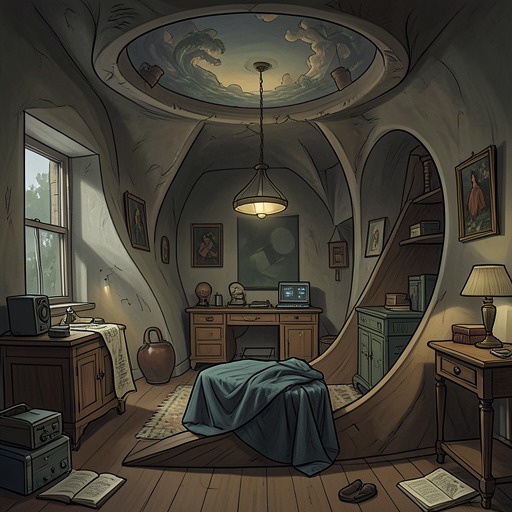
Back inside, the [unnamed narrator](entity:character-recall-character-unnamed-narrator-66e83df570e7) sees a tired man standing on the ceiling and glimpses a succession of empty rooms connected through impossible doors. He realizes that the figures’ distorted faces reflect what they have seen rather than simple malice.
He concludes that the house is harmless in itself but is standing where nothing should stand, making it a trap that draws consciousness deeper with every attempted movement. The place is therefore an ontological hazard rather than a conventional haunted building.
December 7 before dawn
Esther Disappears
The [unnamed narrator](entity:character-recall-character-unnamed-narrator-66e83df570e7) believes that [Esther](entity:character-recall-character-esther-b91ff5ee0c38) is sleeping safely beside him, but she vanishes while he watches and waits. He understands that the house may not hold everyone equally: the child seemed less affected than he was, yet he could not know whether sending her away alone would have helped.
Her disappearance strips away the last immediate object of his protective role. He fears that outsiders will interpret the event as a father’s collapse after marital betrayal, while he knows that the house itself has taken her.
December 7 before dawn
Voices Through Time
The [unnamed narrator](entity:character-recall-character-unnamed-narrator-66e83df570e7) hears footsteps above, a shattered object, and a closing front door, but the disturbances no longer frighten him as much as the larger implications of the space. He imagines that other versions of himself may be moving through the house at different times.
He tries to send a warning backward through undulating time, repeating “[Get away](entity:expression-recall-expression-get-away-7538652fe5fa)” so that the earlier man might read or hear it before becoming trapped. The attempt fails, and he realizes that the warning has already been part of his own record without changing his fate.
December 7 morning
Susanna Returns
As daylight arrives, the [unnamed narrator](entity:character-recall-character-unnamed-narrator-66e83df570e7) hears an engine and runs through an impossibly lengthened upper corridor. He reaches the front door and finds [Susanna](entity:character-recall-character-susanna-cf043f83c901) waiting in the car with [Esther](entity:character-recall-character-esther-b91ff5ee0c38), who is feverish but alive.
Susanna explains that she has been worried and says that [David](entity:character-recall-character-david-a0465b0b2f3d) means nothing to her and that the affair was a terrible mistake. The narrator barely responds, because the rescue has not restored the life they left behind; Esther’s fever and his altered identity make normal reunion impossible.
December 7 morning
The Narrator Refuses Rescue
The [unnamed narrator](entity:character-recall-character-unnamed-narrator-66e83df570e7) tells [Susanna](entity:character-recall-character-susanna-cf043f83c901) to drive away without him. He says that he needs time to think and that the [Vacation House](entity:location-recall-location-vacation-house-f1a6ddb30b38) is a good place for that, urging her to trust him and leave quickly.
He embraces her while feeling divided between the man who wants to return to his family and the being who now belongs to the house. Susanna drives away with [Esther](entity:character-recall-character-esther-b91ff5ee0c38), and the narrator remains behind, choosing the impossible refuge over ordinary reconciliation.
near the ending
The Final Empty Reflection
After [Susanna](entity:character-recall-character-susanna-cf043f83c901) and [Esther](entity:character-recall-character-esther-b91ff5ee0c38) disappear down the road, the [unnamed narrator](entity:character-recall-character-unnamed-narrator-66e83df570e7) returns to the [Vacation House](entity:location-recall-location-vacation-house-f1a6ddb30b38). Rain streaks the window, and the room appears clearly in reflection without any person in it, though a notebook remains on the table.
The image completes the progressive separation of the narrator from his family, his body, and ordinary reality. His written account survives as the only apparent trace of a consciousness that has been absorbed into the house.
final moment
The Unfinished Notebook
The [unnamed narrator](entity:character-recall-character-unnamed-narrator-66e83df570e7) begins to write one last sentence, but the account ends before it can be completed. The notebook is left in the reflected room, preserving fragments of the marriage, the affair, the failed screenplay, and the house’s impossible geometry.
The unfinished ending denies closure and suggests that the narrator’s warning, like the house itself, may circulate across times and dimensions without reaching an escape. His story remains both testimony and another layer of the trap.